
Skip links

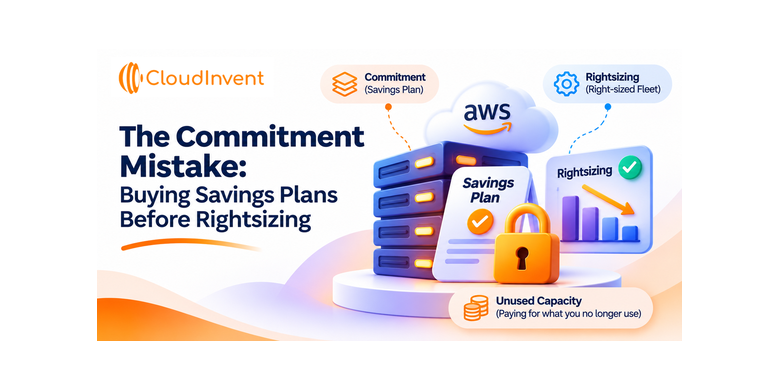
The Commitment Mistake: Buying Savings Plans Before Rightsizing.

Buy Savings Plans after you right size, or at least model both together. A commitment sized to today's oversized fleet locks you into paying for capacity you may shrink next quarter. Sizing the commitment to the rightsized fleet avoids that, and keeps the savings you report honest.
November 6, 2026
The Commitment Mistake Buying Savings Plans Before Rightsizing

Lower rates don't always mean lower cloud costs: Buying Savings Plans before optimising your infrastructure can leave you committed to compute capacity you no longer need. The smarter approach is to evaluate rightsizing opportunities, existing commitments and future usage together before making a purchase.

How the mistake happens

It usually starts with a good intention. Finance wants a lower rate, so the FinOps team buys a Savings Plan covering current compute usage. A month later, engineering rightsizes several instance families and usage drops.

Savings
Plan
✓

Buy a
Savings Plan

(for current usage)

→
⚙

Rightsize
the fleet

(remove unused capacity)

→
↘

End up with
unused commitment

(you still pay for it)

An illustrative example

(Not customer data)

You commit to cover your current compute spend. Then rightsizing reduces that spend. The commitment does not shrink with it.

$100K
Commitment (what you pay for)
$70K
Usage after rightsizing
$30K Unused capacity (paid for)

Why teams do it in the wrong order

Different
owners

Commitments sit with FinOps and finance. Rightsizing sits with engineering.

Different
tools

Rate and usage optimization are often analyzed in separate reports.

Urgency

A rate discount is quick to buy. Rightsizing takes engineering time.

The right approach:
one calculation

The two levers interact, so they should be modeled together. A good recommendation answers one question: given the fleet we expect to run after rightsizing, how much should we commit?

Rightsizing

(run a leaner
fleet)

%

Savings
Plan

(get a lower
rate)

One
calculation

✦

The problem is that a Savings Plan commitment does not automatically adjust when your infrastructure changes. If you commit based on your current compute usage and then reduce that usage through rightsizing, the gap becomes unused capacity that you still pay for. What looked like a smart rate-saving decision can turn into avoidable cloud spend. Understanding this gap is the first step towards making commitments that reflect the infrastructure you actually need.

How CloudInvent handles it

⚙

AWS Compute Rate Optimization

Produces Savings Plan recommendations that include rightsizing and account for unused Savings Plan capacity. Rate savings appear in the Executive Summary alongside your other savings.

✦

AI-Powered Savings Recommendations

Weighs rightsizing and commitments together, so the total you see reflects how the two interact, rather than adding two separate numbers that overlap.

A simple checklist
before you commit

✓ ✓ ✓
1

Check for pending rightsizing. Are engineers planning changes to the instances you are about to cover?

2

Model both together so the commitment fits the future fleet.

3

Count existing capacity, including Savings Plans you are not fully using.

4

Stagger purchases instead of committing everything at once.

5

Report savings on one basis, so finance and engineering agree on the result.

A Savings Plan commitment is designed to deliver lower rates over time, but its value depends on how accurately it matches your actual infrastructure needs. When rightsizing changes your compute usage, an existing commitment may no longer align with your reduced spend. Without considering both together, you risk paying for capacity you no longer need and overstating the savings your optimization efforts deliver. Understanding how these two decisions interact is essential to making smarter commitments and keeping cloud costs under control.

COMMON QUESTIONS

Frequently asked questions

Should I always rightsize first?

Not necessarily. The point is to model them together, so you commit to the fleet you expect to run.

What happens to unused Savings Plan capacity?

You pay for it either way. That is why new recommendations should count it.

Do commitments still make sense?

Yes. Steady workloads benefit from them. The goal is to size them correctly.

MAKE SMARTER COMMITMENTS

See Savings Plan recommendations
built for the fleet you will actually run.

Book a demo →

Continue reading

5 FinOps Mistakes That Cost Enterprises Millions

Read article →

How Machine Learning Powers Smarter Cloud Operations

Read article →

Rightsizing and Rate Optimization: Two Levers, One Goal

Read article →